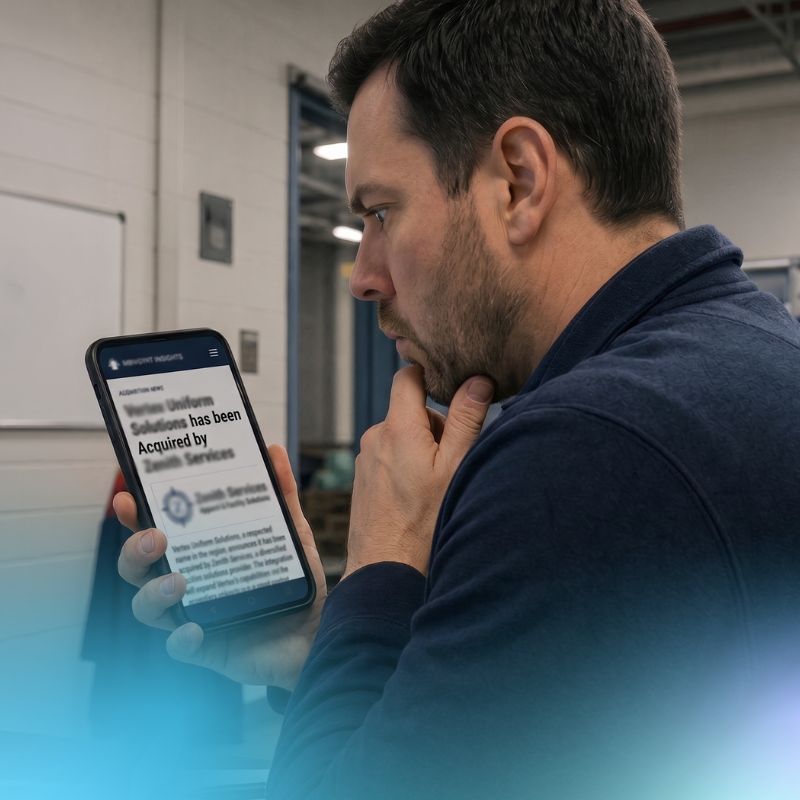
If Your Uniform or Facility Service Provider Was Acquired: Questions to Ask Before Service Changes
“Still the same service you know and trust.” It’s a common message when ownership changes.
And often, that’s exactly the intention. Most providers aim to maintain continuity in service, contacts, and operations, especially in the early stages of a transition.
But as systems, processes, and teams are integrated over time, adjustments can still take place. These aren’t always immediate, and they’re not always disruptive but they can influence how service is delivered over time. Sometimes these changes are for the better, but it’s important to know your new partner and determine whether the changes meet your needs.
This isn’t about expecting problems. It’s about asking the right questions early so your service stays predictable, reliable, and aligned with your operation.
What Actually Changes After an Acquisition?
Even when service appears unchanged at first, ownership transitions can gradually influence how that service is delivered.
Decision-making moves from local teams to centralized structures Decisions that were once handled locally may now be routed through a head office, sometimes in another region, adding layers to approvals and response times.
Escalation paths change Resolving issues may involve more steps or additional contacts, which can impact how quickly concerns are addressed.
Routes or service are adjusted Delivery reliability or service support may be adjusted to improve efficiency across a larger network, which can affect timing, frequency, or consistency.
Service expectations become more standardized Processes that were once flexible at a local level may shift toward more defined, company-wide standards.
Product offerings may change Products or services that were previously available may shift over time. It’s worth confirming whether your current needs can still be met, and whether any new offerings may be worth considering.
Even when service appears unchanged at first, ownership transitions can gradually influence how that service is delivered.
The extent of these changes can vary depending on how the organization is structured and how operations are managed moving forward.
6 Questions That Protect Your Program
If service is going to evolve over time, asking a few practical questions early can help keep expectations clear and avoid surprises.
Who is now responsible for decisions on my account, and where are they based? This helps clarify whether decisions are still handled locally or now routed through a head office or another region.
If there’s an issue, what is my escalation path and expected response timeline? Ask for clear response expectations and who steps in if your representative is unable to resolve an issue.
Will contracts, terms, or renewal structures be revisited? Understanding if updates are planned helps you prepare ahead of renewal periods.
Have garment standards, repair policies, or replacement thresholds changed? These details can influence garment lifespan, employee experience, and replacement costs.
Will service flexibility change for special requests or urgent needs? Ask how exceptions, rush requests, or last-minute changes are handled under the current structure.
How will changes be communicated, and how often? Confirm whether updates will be proactive and whether you will be informed before changes take effect.
Early Signs Your Service May Be Shifting
Changes in service are rarely announced outright. More often, they show up in how routine interactions start to feel slightly different.
You may notice it in how easily you can get a clear answer, how issues are handled from one visit to the next, or how much continuity there is in your service experience. These shifts are usually subtle at first, but they can point to broader changes in how the service is being managed.
Common early indicators include:
Having to go through general service lines or multiple contacts to reach the right person
Less continuity in communication or service visits, requiring you to re-explain details
Invoices requiring more time to review or reconcile due to changes in format, line items, or billing structure
Longer resolution times for routine issues, requiring more follow-up than expected
Less flexibility when handling requests or exceptions with more standardized responses instead of tailored solutions
Individually, these may not seem significant. But when they start to appear together, they usually point to a shift in how your service is being managed.
Before Changes Are Set Into Service
When ownership changes are announced, communication doesn’t always happen all at once or with the level of detail customers may expect.
In some cases, you may hear about the change publicly before you’ve had a chance to understand what it means for your own service, or before you’ve had a direct conversation with your provider.
That’s why it helps not to wait for answers to appear over time, or for changes to become part of your service experience.
Reaching out early, once a transition is announced or shortly after, gives you a clearer understanding of what to expect and where things may evolve. It also allows you to prepare, rather than adjust after changes are already in place. It’s important you get to know your new partner to determine how these changes will impact you and your team.
When ownership changes happen, customers are often reassured that service will remain the same especially when what’s already in place is working well.
But with a shift of that scale, some aspects of service will likely evolve overtime.
Understanding where those changes may occur, asking a few practical questions early, and recognizing the signs as they appear can help you stay ahead of them.
How service is structured and how closely decisions stay tied to your operation often shapes that experience more than size alone. Different providers approach service in different ways.
If you’ve recently heard about a change with your provider, it may be worth having a conversation and getting clarity early, rather than waiting for those changes to settle in.
Explore how partnering with a uniform service provider helps businesses manage seasonal staffing surges by ensuring consistent quality, safety compliance, and efficient uniform scaling.
Shop towels are used every day—but managing them properly isn’t always as simple as it seems. Learn what goes into handling, cleaning, and maintaining shop towels, and why a consistent system matters.